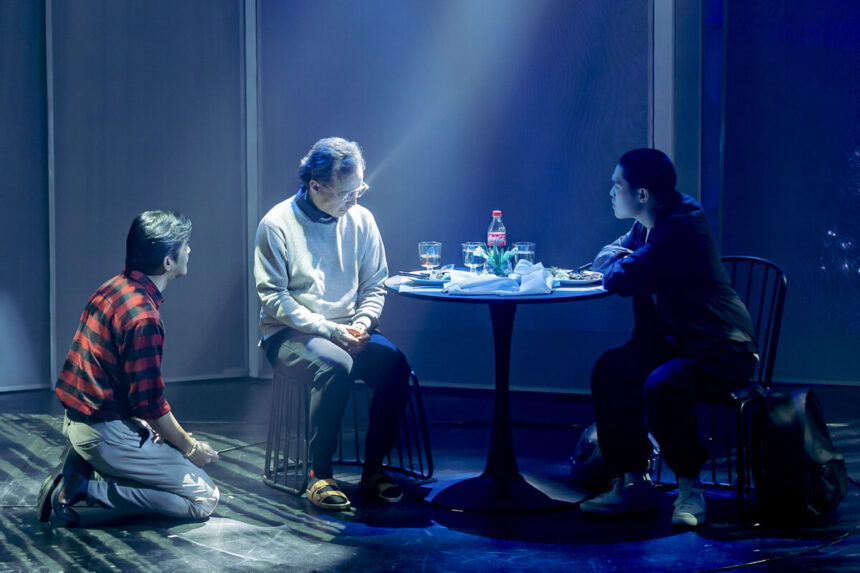
Some stories stay with you long after the curtain falls. They make you think about the characters, their choices, and the things they may never fully understand about one another. About Us But Not About Us, written by Jun Robles Lana and adapted from his film of the same name, is one such story. Presented by IdeaFirst Live and directed by Tuxqs Rutaquio, the stage play explores love, grief, secrets, and complicated relationships through conversations that gradually reveal more than what the characters initially let on.
The story follows Eric, a University of the Philippines English literature professor, and Lancelot, his former student. Their connection to Marcus, Eric’s longtime partner of 17 years and someone Lancelot looked up to for guidance and support, is at the heart of the drama. As the characters talk about their experiences with Marcus, their conversations reveal different perspectives, unresolved feelings, and questions about what really happened.
I watched the stage play before seeing the original film, which made the experience especially interesting. I went into the theater without having seen the movie, so I could follow the story as it unfolded onstage. The performances, stage design, and emotional confrontations drew me into the characters’ lives, while the story kept me thinking about how differently people can remember the same events.


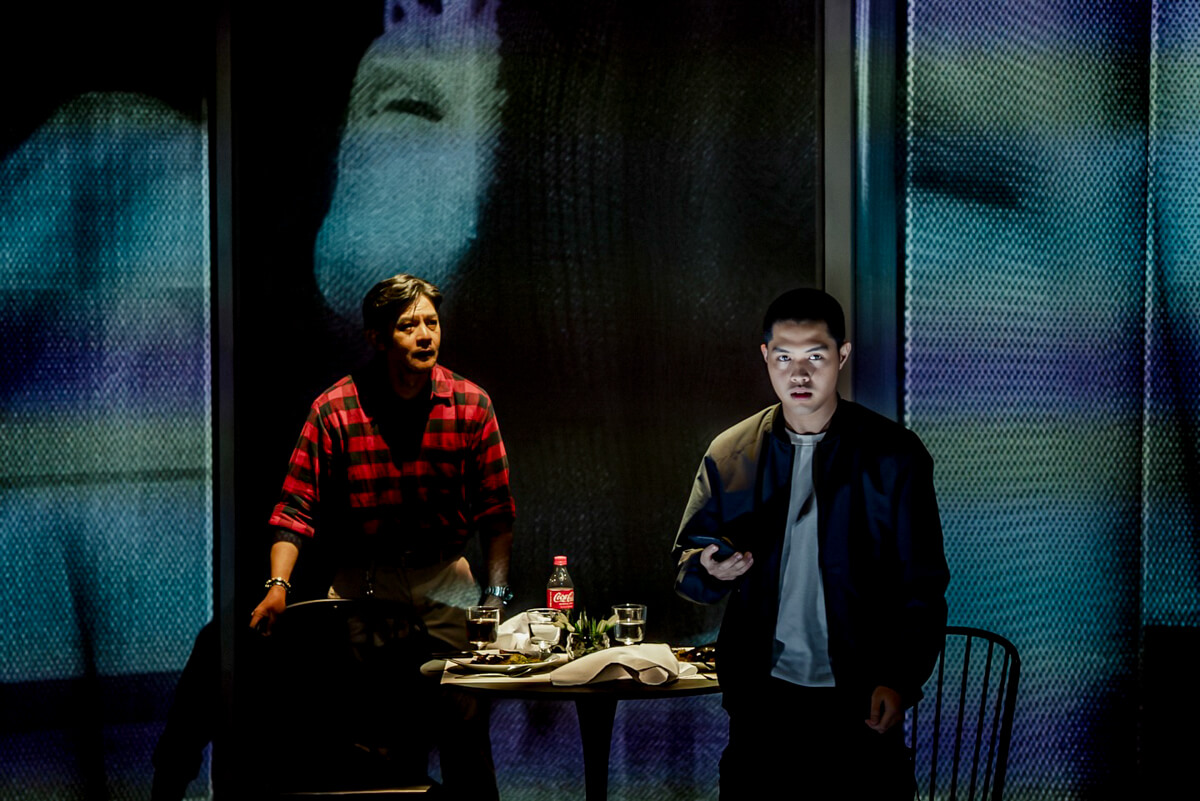
A Story About Grief, Secrets, and Complicated Relationships
At first, About Us But Not About Us may seem like a story about three people connected by their relationships with one another. As the conversations develop, however, it becomes clear that there is much more beneath the surface. The play explores how grief, personal experiences, and conflicting memories can affect the way people see one another.
Eric’s relationship with Lancelot is particularly complicated. Eric is portrayed as someone who genuinely wants to protect Lancelot, but the play gradually reveals the complicated power dynamics behind their relationship. What Eric sees as care and concern also raises questions about control, boundaries, and the influence he has over his former student.
Lancelot, meanwhile, admired Marcus, who played an important role in his life. When Lancelot experienced physical abuse from his stepfather, Eric allowed him to stay at his condominium despite Marcus’s disapproval. This part of their history adds another layer to the relationships, showing how the characters’ decisions and personal beliefs can lead to tension.
The play also explores how people try to influence the way others see them and their experiences. As Eric and Lancelot revisit the past, their conversation becomes more complicated, particularly when their memories and interpretations do not fully align. Their exchanges encourage the audience to look beyond what is being said and consider why each character may see things differently.
What makes the story engaging is that it does not simply tell the audience what to believe. Instead, it allows the characters to reveal their perspectives gradually. This keeps viewers thinking about the events and questioning whether they have the complete picture.
Powerful Performances Bring the Characters to Life
The cast plays a major role in making the story work. The production features Epy Quizon and Andoy Ranay alternating as Marcus, Romnick Sarmenta and Tuxqs Rutaquio alternating as Eric, and Elijah Canlas and Kobie Brown alternating as Lancelot.
Because the play relies heavily on conversations, the actors must communicate the characters’ emotions through their words, expressions, and reactions. Even a pause or a subtle change in tone can make a difference, especially when a scene leaves the audience wondering whether a character is being completely honest.
Eric’s character stands out because his actions can be viewed in different ways. His desire to help Lancelot may come from genuine concern, but the play also asks viewers to consider when protection can become control. This makes their relationship more complicated than it might initially appear.
Lancelot brings another perspective to the story. His admiration for Marcus, his ambitions, and his relationship with Eric all influence how he responds to the events surrounding him. His online following also becomes part of the conflict, particularly when Eric asks him to delete content connected to his experiences.
Marcus, meanwhile, remains an important presence in the story because of his relationships with both men. His connection to Eric and Lancelot helps drive the drama, while the different ways they remember him add to the uncertainty surrounding their shared past.
The performances work together to maintain the tension without relying on constant dramatic action. Much of the impact comes from watching the characters talk, react, and gradually reveal their feelings. As their conversations become more intense, even small gestures can make a scene feel more revealing.
An Emotional Moment That Stayed With Me
While the play has plenty of psychological tension, its emotional moments are just as memorable. Beneath the secrets and conflicting accounts is a story about love, loss, and the difficulty of letting go of relationships that have shaped a person’s life.
One of the most affecting scenes for me was the confrontation between Marcus and Eric. After learning more about their relationship, seeing them face their unresolved feelings made the moment especially powerful. It showed how years of shared experiences can make a relationship difficult to leave behind, even when hurt and disappointment have become part of it.
What I appreciated about this scene was how personal it felt. The emotions were connected to the history between the characters, making their confrontation about more than the disagreement in front of them. It reflected the pain of carrying unresolved feelings and trying to make sense of a relationship that has changed over time.
And yes, I cried.
The play gives these emotional moments room to breathe. Instead of making every scene overly dramatic, it allows the characters’ words and reactions to carry the weight of their experiences. This balance between emotional storytelling and psychological tension is one of the reasons the production stayed with me.
Stage Design Adds Another Layer to the Story
The stage design helps bring the story to life without distracting from the dialogue. The revolving stage and transparent or sliding panels allow the setting to change as the story moves forward. Lighting and sound also help establish the mood, especially when the conversations become more tense.
I also appreciated the everyday details incorporated into the scenes, including the use of food and drinks onstage. These familiar elements make the interactions feel more natural, creating a contrast with the difficult subjects the characters discuss.

Another detail that caught my attention was Marcus’s rose-gold aviator glasses. The frame used in the stage production is the SoYou Metal SYM3206 in Rose Gold from Starfinder Optical.
The glasses are especially interesting because they also play an important role in the original film. In the movie, Eric and Lancelot portray Marcus in flashback scenes, with the glasses serving as a visual cue. When either character wears them, it signals that the scene is presenting Marcus through that portrayal.
This makes the glasses more than just an accessory. They help the audience recognize a shift in the story and connect the characters to their memories of Marcus. It is a small but meaningful detail that shows how a prop can contribute to the way a story is told.
Watching the Stage Play Before the Movie
Watching the stage play before the original film gave me a different way to experience the story. I was able to meet the characters through the live production first, without comparing the actors or scenes to the movie as I watched.
The stage adaptation also gave me a chance to focus on the conversations and the actors’ performances. Since much of the story unfolds through dialogue, the way each character speaks, reacts, and responds to the others is important to understanding the relationships.
The film’s use of Marcus’s glasses as a visual cue also made me more interested in how the two versions tell the story differently. In the movie, Eric and Lancelot portray Marcus during flashback scenes when they wear his glasses. Onstage, Marcus is portrayed directly by an actor, with Epy Quizon and Andoy Ranay alternating in the role. This gives the stage production a different way to present the character and his place in the story.

I also spotted a copy of Teorya ng mga Tanong being sold outside the theater. Since the title is mentioned in the production, I became curious about the book and its connection to the story. I have yet to read it, so I cannot say whether the copy sold at the venue is the same book referenced in the story or a separate publication. It is something I hope to find out when I get the chance to read it.
Having seen the stage play first, I am now interested in comparing it with the original film. Experiencing both versions offers an opportunity to see how the same story can be presented in different ways while retaining its central relationships and tension.
Final Verdict: A Stage Play Worth Watching
About Us But Not About Us is a thought-provoking stage play that combines strong performances, emotional storytelling, and psychological tension. Its focus on grief, complicated relationships, and conflicting perspectives gives audiences plenty to think about, even after the performance ends.

What I found particularly engaging was the way the story encourages viewers to question what they hear rather than immediately choosing a side. The characters have their own reasons for seeing events differently, and the play gradually reveals how personal feelings and relationships can influence their accounts of the past.
The production’s stage design also supports the story well, from the revolving stage and lighting to the details that help establish the characters and their surroundings. The rose-gold glasses are another memorable element, particularly for viewers interested in the connection between the stage adaptation and the original film.
For anyone who enjoys Filipino theater, character-driven drama, and stories that explore the complicated side of human relationships, About Us But Not About Us is worth watching. It is an emotionally engaging production that leaves room for reflection and conversation long after the final scene.
Catch About Us But Not About Us in Makati
About Us But Not About Us, written by Jun Robles Lana, directed by Tuxqs Rutaquio, and presented by IdeaFirst Live, runs from October 2 to 25, 2026, at the Power Mac Center Spotlight Blackbox Theater in Circuit Makati.
The production features alternating casts, with Epy Quizon and Andoy Ranay as Marcus, Romnick Sarmenta and Tuxqs Rutaquio as Eric, and Elijah Canlas and Kobie Brown as Lancelot.
For ticketing information, visit the official IdeaFirst Company show buyers directory.
Starfinder Optical Giveaway for Ticket Holders
Starfinder Optical is also holding a giveaway for ticket holders of About Us But Not About Us. Three lucky winners can each receive one SoYou eyewear frame with a BlueCut Lens Upgrade.
Registration runs from October 9 to 26, 2026. Interested participants can check the giveaway post for the complete mechanics and eligibility requirements, then register through the official giveaway form.


Thank you to Starfinder Optical for inviting us to watch About Us But Not About Us. It was a memorable theatrical experience, and I’m glad I had the opportunity to see the stage production before watching the original film.