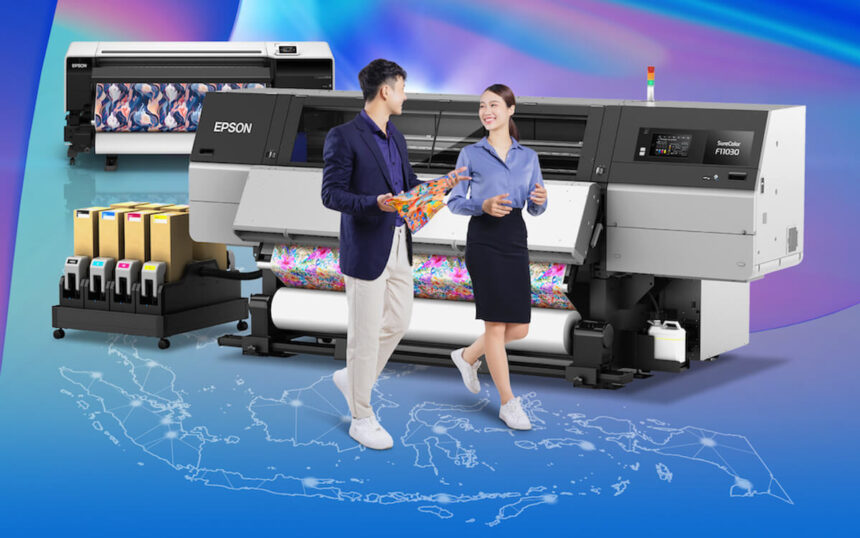
Epson, a global leader in professional printing, has released a new whitepaper developed in collaboration with global market intelligence firm International Data Corporation (IDC) titled Digital Textile Printing Trends in Southeast Asia. The report is based on a regional survey of textile print provider owners and key decision makers across the Philippines, Indonesia, and Thailand. The findings highlight the growing importance of digital dye-sublimation technology in reshaping Southeast Asia’s textile printing landscape.
As customer expectations continue to evolve and sustainability and economic pressures intensify, print providers across the region are increasingly adopting advanced digital solutions to remain competitive. The whitepaper underscores how digital dye-sublimation is emerging as a critical technology for addressing demand for customization, speed, and operational efficiency.
Growing Demand for Customization and Short-Run Printing
The appetite for customized and sustainable textile solutions in Southeast Asia has driven significant growth in digital dye-sublimation adoption. According to IDC, the number of digital dye-sublimation printers shipped across Asia Pacific has doubled from fewer than 1,500 units in 2017 to more than 3,000 units anticipated by the end of 2025.
Print providers are facing unprecedented demand for durability, high-quality output, and faster turnaround times. The research reveals that 44 percent of print providers identify cost-effectiveness for small runs and customization as the primary motivator for adopting dye-sublimation technology. The technology is widely praised for its ability to produce vibrant, multi-design outputs, even at a single-item scale.

Unlike traditional screen printing, which requires large minimum print runs and extensive setup, digital dye-sublimation enables efficient short-run and on-demand production. In addition to printing fabric rolls, providers are now able to produce smaller applications such as textile labels and tags, further expanding their service offerings.
Digital Dye-Sublimation Unlocks Opportunities for 8x Growth
The report reveals that companies investing in digital dye-sublimation technology are achieving revenue growth at a significantly faster pace than those relying solely on legacy screen printing. Over a 24-month period, businesses using digital dye-sublimation recorded average growth rates of 8.4 percent, compared to growth slightly above 1 percent among screen-printing-only providers.
The flexibility of dye-sublimation allows print providers to offer vibrant, multi-design outputs within a single batch. This capability enables personalization at scale without compromising efficiency or increasing costs. As a result, three in five or 60 percent of print providers have expanded into new customer segments, including event organisers, brand owners, and fabric designers.
In Southeast Asia, rising participation in outdoor activities such as marathons and hiking has further fueled demand for customized apparel. The research shows that more than four in five or 81 percent of print providers now serve the apparel and sportswear market, particularly for polyester-based garments that are well suited for dye-sublimation printing. The study also identified emerging growth opportunities in the homeware segment at 36 percent and the footwear segment at 33 percent.
More than half or 52 percent of surveyed providers reported improved customer experiences, citing faster turnaround times and the ability to deliver complex customized designs. These capabilities are areas where traditional screen printing continues to face limitations.
Strong Sustainability Commitment from Southeast Asian Industry Practitioners
As Southeast Asia strengthens its role as a global textile production hub, Epson’s Infobrief highlights how print providers are integrating digital dye-sublimation technology into their sustainability strategies.
While sustainability is not yet a universal purchasing requirement among customers, print providers increasingly view it as a strategic priority. Seven in ten providers consider sustainability important to their business, even when customers do not explicitly demand it. Among businesses exclusively using digital dye-sublimation, this figure rises to 88 percent. However, only one-third of providers believe their customers place the same level of importance on sustainability, revealing a gap that presents opportunities for improved communication and education across the industry.
Reducing Waste and Safeguarding Worker Safety
Beyond driving growth opportunities at 49 percent and reducing environmental impact at 24 percent, sustainable printing practices are delivering measurable operational benefits. Compared to traditional screen printing, which often relies on large volumes of water, harsh chemical inks, and generates significant waste, digital dye-sublimation offers a more environmentally responsible alternative.
IDC’s findings also highlight improvements in workplace health and safety. Among dye-sublimation users, 33 percent reported enhanced employee safety through reduced direct contact with chemical inks and minimized exposure to harmful emissions.
This combination of environmental responsibility, cost efficiency, and improved workplace safety positions digital dye-sublimation as a transformative technology for the future of Southeast Asia’s textile printing industry.
“While there is clear industry momentum towards sustainable printing, the research highlights a gap between provider ambition and customer priorities,” said Masako Kusama, President and Director of Epson Philippines Corporation (EPC). “This creates an opportunity for technology leaders like Epson, alongside industry partners, to better communicate the proven business, environmental and health benefits of sustainable practices.”
“Digital dye-sublimation is not only eco-conscious, but it also reduces energy use, limits chemical exposure for workers, cuts waste and opens high-value market opportunities. By partnering with providers to integrate advanced, energy-efficient technologies, we aim to empower Southeast Asia’s print industry to compete more effectively while contributing to a more sustainable future.”