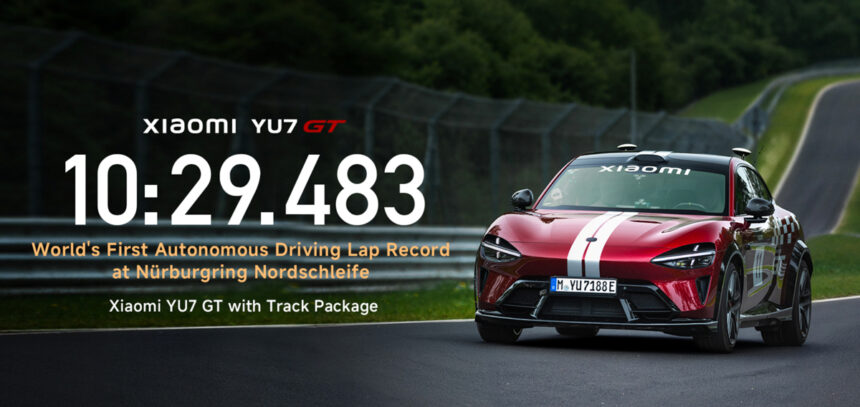
Xiaomi EV has achieved a world first in autonomous driving at the Nürburgring Nordschleife, marking a major milestone for the company’s autonomous driving technology. A Xiaomi YU7 GT equipped with the Track Package successfully completed the full 20.8-kilometer Nürburgring Nordschleife circuit entirely without a human driver, recording an official lap time of 10:29.483.
The autonomous driving test was conducted and certified in accordance with the Nürburgring’s official timing procedures. Following this achievement, the Nürburgring introduced a new official category, AUTONOMOUS DRIVING under ELECTRIC VEHICLES, recognizing autonomous driving performance in electric vehicles.
The achievement highlights Xiaomi EV’s continued progress in autonomous driving technology while demonstrating the capabilities of artificial intelligence and advanced vehicle control systems under one of the world’s most demanding driving environments.
Xiaomi YU7 GT Completes the Nürburgring Nordschleife Without a Human Driver
During the challenge, the Xiaomi YU7 GT autonomously completed all driving tasks across the Nordschleife’s 73 corners, approximately 300 meters of elevation change, and a wide range of complex, continuously changing road surface conditions.
Widely recognized as one of the world’s most demanding automotive proving grounds, the Nürburgring Nordschleife combines high-speed sections, consecutive technical corners, constantly varying grip levels, and extremely limited margins for error. The circuit has long served as a benchmark for vehicle engineering, development, and performance validation because of its ability to test vehicles under challenging real-world conditions.
Completing the full course entirely without a human driver validates the comprehensive capabilities of Xiaomi’s autonomous driving system under extreme dynamic conditions. The accomplishment also demonstrates the potential unlocked through the deep integration of artificial intelligence and advanced vehicle control technologies, highlighting how AI continues to play an increasingly important role in the future of autonomous mobility.
Xiaomi Continues Advancing Autonomous Driving Technology
Since the launch of Xiaomi HAD in 2024, Xiaomi has continued advancing its autonomous driving technology through ongoing engineering development and system improvements.
In March 2026, Xiaomi introduced a new vehicle platform powered by the next-generation Xiaomi XLA architecture and the MiMo-Embodied foundation model. The upgraded platform features enhanced understanding and reasoning capabilities, allowing the system to better interpret complex environments, dynamic traffic participants, and vehicle states. These improvements continue driving the evolution of autonomous driving from behavior imitation toward deeper environmental understanding and autonomous decision-making.
Xiaomi’s autonomous driving system is built on an end-to-end architecture combined with a vehicle dynamics model. This enables the system to perceive vehicle states and road conditions in real time while making control decisions through dynamic prediction.
Under high-speed and high-load driving conditions, the autonomous driving system continuously coordinates steering, braking, and power delivery to maintain vehicle stability. The ability to adapt to changing vehicle dynamics while responding to demanding road conditions contributes to the overall performance demonstrated during the Nürburgring Nordschleife autonomous driving challenge.
Nürburgring Testing Supports Future Autonomous Driving Development
Through the Nürburgring autonomous driving project, Xiaomi continues to gather valuable data and system feedback under extreme operating conditions. Information collected during testing supports ongoing improvements in vehicle dynamics modeling, control strategy optimization, and safety redundancy mechanisms.
Testing on the Nürburgring Nordschleife provides Xiaomi with opportunities to validate and refine its autonomous driving technology under challenging conditions that demand precise control, continuous adaptation, and reliable vehicle performance. The project contributes to the company’s broader efforts to strengthen the capabilities of its autonomous driving system through rigorous engineering validation and real-world testing.
As artificial intelligence and automotive technologies continue to converge, Xiaomi remains committed to advancing autonomous driving through engineering innovation and continuous real-world validation. By combining artificial intelligence, advanced vehicle control technologies, and extensive testing, the company aims to deliver safer, smarter, and more efficient mobility experiences for users worldwide.