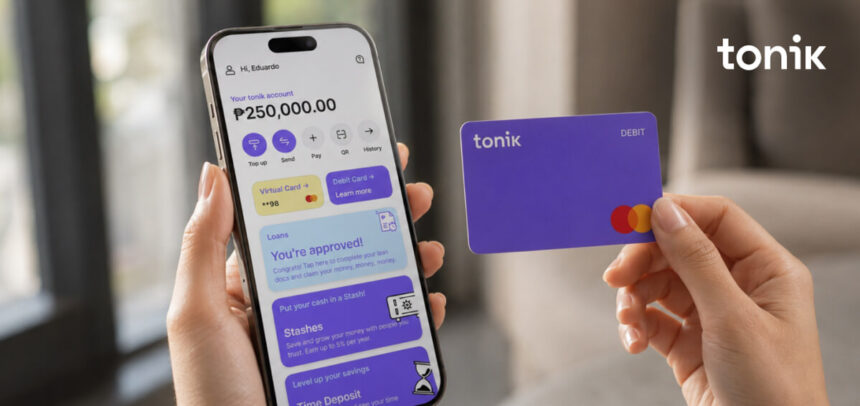
Tonik, the holder of BSP Digital Banking License No. 001 and the Philippines’ first standalone digital bank, has achieved sustained profitability, marking a major milestone in the country’s digital banking sector.
Tonik is a Philippine digital bank focused on consumer lending and operates as a standalone institution without reliance on a parent bank or ecosystem. It generated consolidated positive cash net income after all costs, including cost of risk, in Q1 2026. This makes Tonik the first standalone digital bank in the Philippines to reach profitability and one of the fastest non-ecosystem neobanks globally to achieve this milestone.
This profitability reflects a lending-first business model built on credit efficiency rather than user acquisition scale.
At the same time, Tonik’s regulated bank subsidiary, Tonik Digital Bank, Inc., also achieved IFRS profitability for the entire Q1 2026 period.
This outcome is the result of a foundational strategy: building a credit-led digital bank rather than a user-centric platform.
A Credit-Led Model Built for Lending, Not Optics
Unlike many digital banks in the Philippines that prioritize user growth, deposits, or payments activity, Tonik was designed from inception as a lending institution.
Its core focus is deploying capital efficiently into consumer credit for the 90% of Filipinos who remain unserved by traditional bank lenders.
The strategy is anchored on a key financial principle: revenue per loan customer is significantly higher than revenue from payment-only users, making credit inclusion the largest untapped opportunity in Philippine financial services.
This positions Tonik within a structural gap in the market where credit access remains more limited than digital payments adoption.
Five years into operations, this disciplined approach is now reflected in measurable outcomes across profitability, capital efficiency, and portfolio performance.
The Numbers That Define Performance
As of April 2026, Tonik’s performance reflects a highly efficient lending engine:
- Loan portfolio: USD 110 million, up 2.3× year-on-year, leading growth in the segment
- Annualized revenue run-rate: USD 60M+, with 99% derived from lending
- Net Interest Margin and Lending RAROC: 51% / 25%, among the highest in banking
- Loan-to-deposit ratio: 82%, the highest among Philippine digital banks
- Net LTV/CAC: 23×, demonstrating a strong and scalable customer value engine
Together, these metrics indicate a lending-driven business with unusually high capital efficiency and strong unit economics per customer.
Rather than relying on idle deposits or user accumulation, Tonik’s model is built on active credit deployment and portfolio productivity.
Why the Model Matters in Digital Banking
Tonik is the first digital bank in the Philippines to achieve profitability without dependence on a traditional bank parent, telecommunications group, payments ecosystem, or retail network.
While ecosystem-backed financial platforms can accelerate early customer acquisition, they often face structural limitations in long-term scalability due to constrained unit economics or dependency on partner channels.
Standalone digital banks with strong balance-sheet models, however, have historically demonstrated more durable scalability in global markets.
Tonik’s performance reflects this pattern, positioning it as a structurally independent credit institution with scalable lending capacity.
What Drove Profitability
Tonik’s profitability is driven by three core structural advantages:
AI-Driven Risk Management
Over five years of data development and underwriting refinement have enabled profitable lending even to thin-file borrowers. AI-based credit systems analyze repayment behavior and alternative financial signals, improving credit decisioning and enhancing risk-adjusted returns while maintaining portfolio growth.
Diversified Lending Portfolio
Tonik’s loan book is distributed across employer-channel salary-deduction loans, merchant installment networks, and digital personal loans. This diversification reduces concentration risk and supports stable unit economics across borrower segments.
Structural Deposit Advantage
As a BSP-licensed digital bank, Tonik accesses retail deposits at approximately 3–6 percent, compared to over 15 percent for non-bank lenders. This creates a structural funding advantage that directly improves lending margins.
CEO Comment
Greg Krasnov, Founder and CEO of Tonik Digital Bank, emphasized the strategic discipline behind the milestone:
“Profitability in digital banking is a function of what you choose not to do. We chose not to chase users as a vanity metric. We chose not to build deposits we couldn’t deploy. We built a credit bank—with the best unit economics in the market—and let the income statement follow.
We are now the only player that is both cleanly profitable and structurally positioned with a digital bank deposit license to scale into the $50-100 billion credit gap. That makes us the growth leader today. That is a rare combination, and we intend to press it.”
What Comes Next for Tonik
Tonik now enters its next phase of growth as a leading digital bank focused on expanding its loan portfolio in the Philippines.
Near-term priorities include scaling employer-channel lending through Tendo, expanding merchant installment partnerships, and enhancing revolving credit products designed to increase repeat borrowing behavior and long-term customer value.
This next phase reinforces Tonik’s position as a credit-first institution built for sustainable portfolio expansion rather than short-term user acquisition metrics.